Many RDF and SRF producers still tie their bales with steel wire. It works, and it is familiar. But the steel travels on through the chain and has to be removed or separated somewhere further down the line. At the same time, the market is shifting. Recycling targets across Europe are rising – the EU requires 60% of municipal waste to be recycled by 2030 – and landfill continues to be pushed back. What cannot be recycled is increasingly turned into fuel such as RDF (refuse-derived fuel) and SRF (solid recovered fuel). That makes the choice of baling wire part of an efficient and sustainable processing chain.
What is EcoWire?
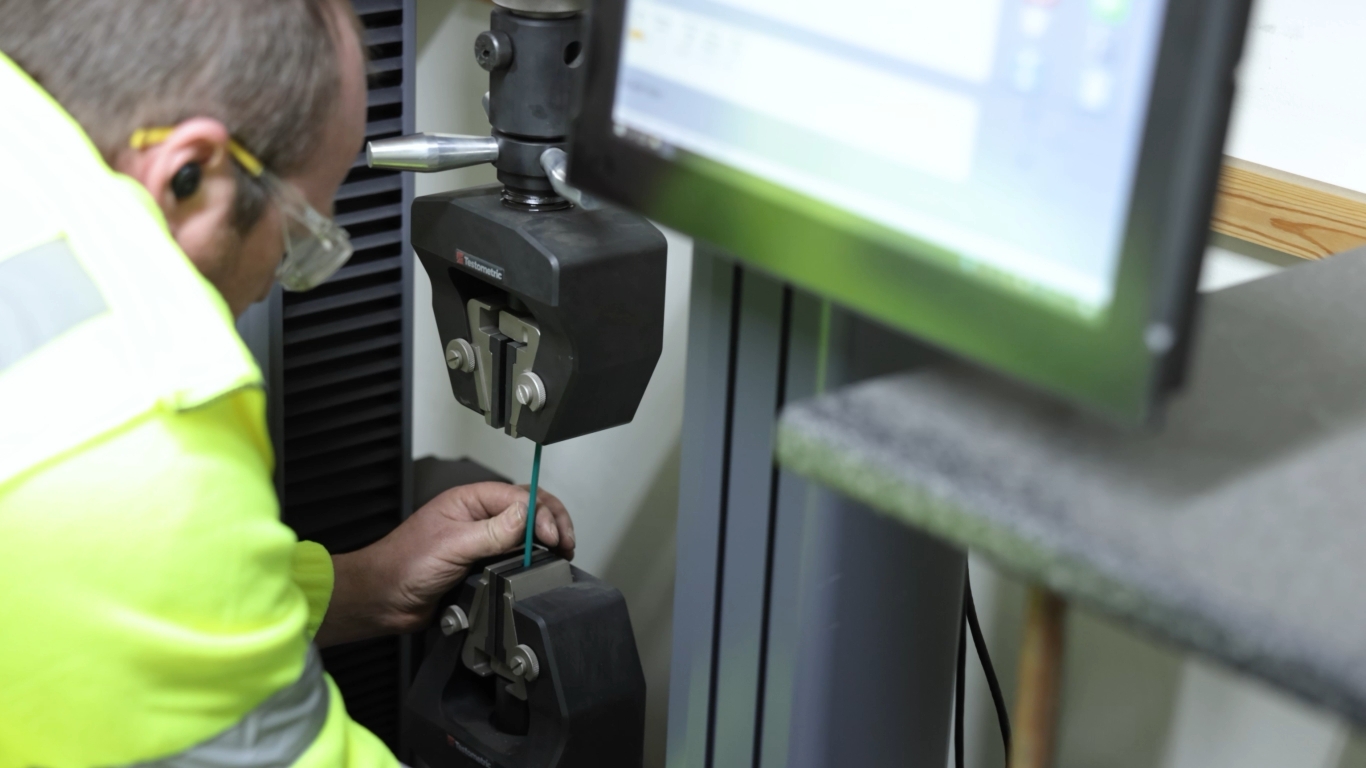
EcoWire (formerly PlasLOC+) is baling wire made from 100% recycled polymer, engineered with Accent's patented technology as an alternative to black annealed steel baling wire. In suitable applications, EcoWire matches or exceeds the performance of steel baling wire, with cleaner and safer handling, reduced machine wear and up to a 90% lower CO₂ footprint than steel on a material basis.
Why keep steel out of the bale?
EcoWire contains no metal. Where steel wire currently has to be removed before or during downstream processing, EcoWire can potentially eliminate that de-wiring step. That saves handling and time, and no steel reaches downstream equipment. The difference shows on the shop floor too: no sharp steel cut ends, no oil or grease, and cleaner working areas.
Technical properties
EcoWire has a square 4.00 × 4.00 mm profile, a breaking load of 420–440 kgf and 20–30% elongation at break. That makes it strong enough to handle baler pressure, while its high flexibility improves tying performance and prevents breakage during knotting. Tight dimensional tolerances ensure uniform feeding and stable behaviour under tension. EcoWire is supplied on spools of up to 12,000 metres (approx. 235 kg).
The benefits at a glance
No metal in the bale or the downstream processing chain
No sharp cut ends, oil or grease during handling
Less wear on cutting, rotating and guiding parts, reducing maintenance and downtime
Four times more wire per pallet than steel (48,000 m versus 12,000 m): fewer deliveries and less storage space
Potential wire savings of 10% or more in suitable applications
Up to 90% lower CO₂ footprint than steel on a material basis
Proven in practice
EcoWire is used by more than 50 customers worldwide, with over 150 million metres of wire applied. RDF operators mainly see less wear on their baler and tying system. One of them uses it to reliably secure RDF bales of up to two tonnes while reducing maintenance costs.
Switching takes planning
Switching from steel to EcoWire is not a like-for-like swap. EcoWire runs on existing balers and follows the same baling process as steel, but it needs a limited number of setup changes. These typically include a new wire payoff system, minor hardware modifications to the needles and twisting hooks, and software tuning with an EcoWire-specific recipe. What exactly is needed depends on the baler, and we would rather confirm that up front than afterwards.
That is why every switch starts with a technical and commercial assessment. Accent evaluates the baler, tying system, OEM requirements and application with the relevant technical partners, coordinates the conversion process and confirms any required modifications, responsibilities and costs before implementation.
Is EcoWire right for your operation?
Share your material stream, baler setup and current wire use. We will assess the technical fit and identify the operational and commercial value for your operation. Request a sample or download the technical data sheet at eco-wire.com.