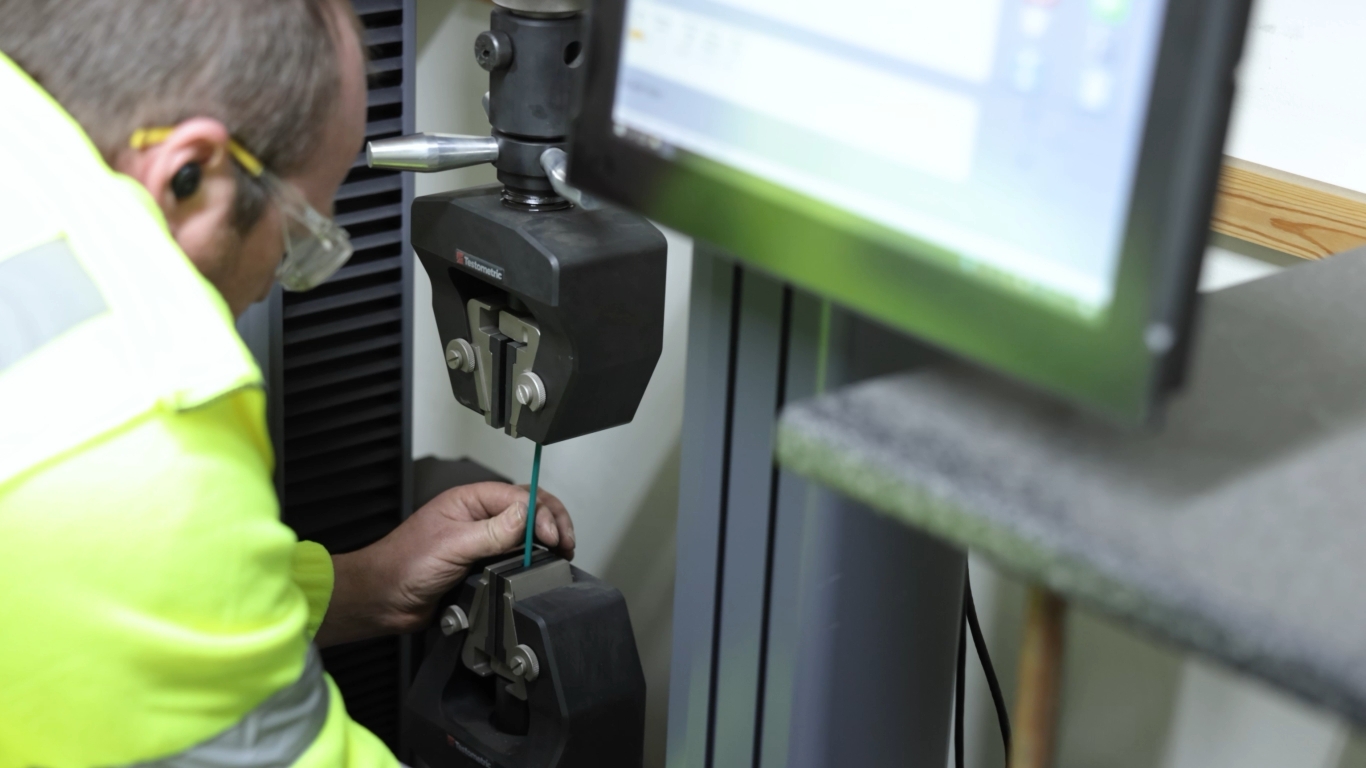
Anyone considering a switch from steel to EcoWire (formerly PlasLOC+) tends to ask the same question: what about torsional strength? It is a fair question. For steel baling wire, torsion has been a familiar quality benchmark for decades. But that benchmark was developed for steel and says little about wire made from recycled polymer. In this article, we explain why, and which specifications to look at instead.
Why torsion matters for steel
Torsional strength indicates how much twisting a wire can withstand before it permanently deforms or breaks. For steel, that is useful information. Steel builds up stress in the material when it is twisted, and a torsion test shows whether the wire can handle that load in the tying system.
Why EcoWire is different
EcoWire responds differently to load. Where steel builds up stress, EcoWire absorbs load through controlled elongation. Its high flexibility improves tying performance and prevents breakage during knotting. A torsion value therefore adds little. Whether EcoWire performs reliably in your baler depends on other properties.
The specifications that define performance
Breaking load: 420–440 kgf. Strong enough for baler pressure and the forces on the bale during transport and storage.
Elongation at break: 20–30%. The wire absorbs stress without breaking, keeping the bale stable.
Knot strength: equivalent to steel. This is ultimately the measure that counts: does the tie hold?
Dimensional stability: a square 4.00 × 4.00 mm profile with a ±0.15 mm tolerance and clover-leaf embossing for grip. That ensures uniform feeding and stable behaviour under tension.
Supply: spools of up to 12,000 metres (approx. 235 kg), pre-loaded onto metal reels, up to four per pallet.
What this means in practice
Because EcoWire contains no metal, no steel ends up in the bale or the downstream processing chain. Where steel wire currently has to be removed, EcoWire can potentially eliminate that de-wiring step. Cutting, rotating and guiding parts also wear less, and sharp cut ends, oil and grease disappear from the shop floor. EcoWire is used by more than 50 customers worldwide, with over 150 million metres of wire applied.
When is EcoWire the right fit, and when not?
EcoWire is not a universal drop-in solution for every baler, tying system or material stream. Material type, bale density, baler configuration, tying system and downstream processing determine whether EcoWire is the right choice. EcoWire runs on existing balers but needs a limited number of setup changes. These typically include a new wire payoff system, minor modifications to the needles and twisting hooks, and software tuning with an EcoWire-specific recipe.
That is why every switch starts with a technical and commercial assessment, in which we confirm what is needed, who is responsible for what and what it costs.
Not sure whether EcoWire fits your operation?
Share your material stream, baler setup and current wire use. We will assess the technical fit and give you honest, technically sound advice. Request a sample or download the technical data sheet at eco-wire.com. eco-wire.com.